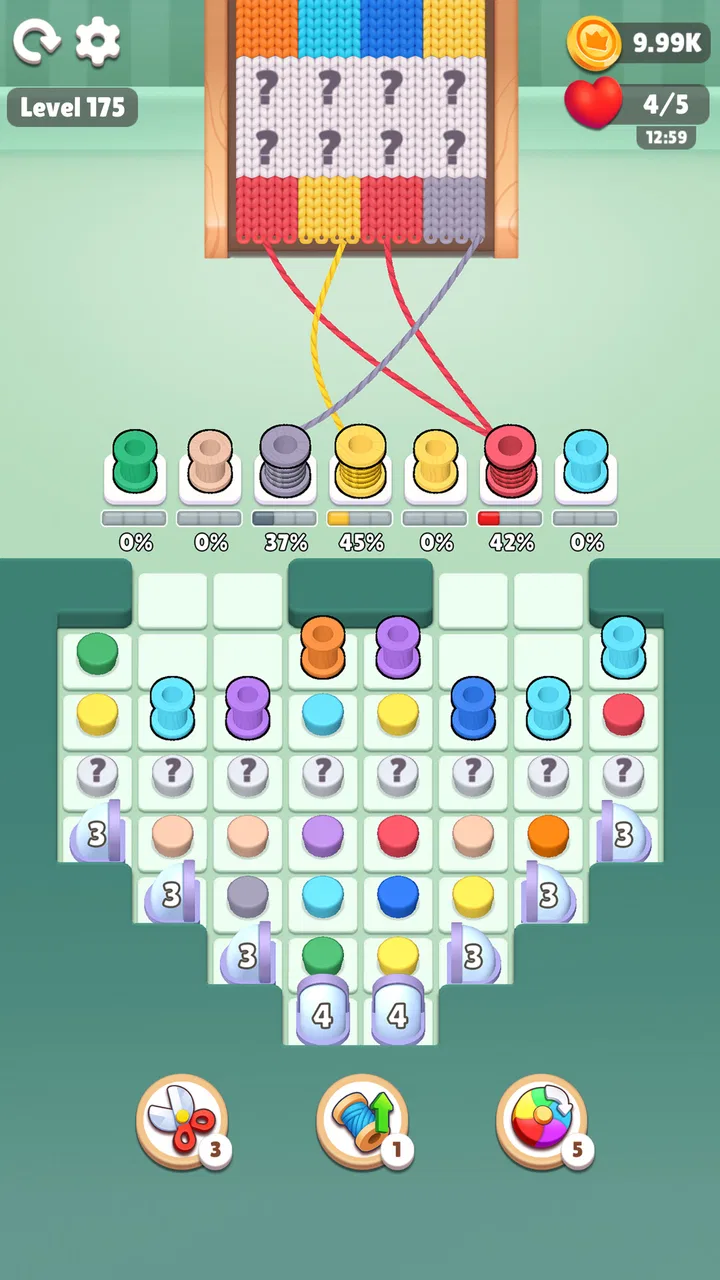
Color Knitzy
- 4.2
- Rating
- 5.00M
- Installs
- Free
- Price

 Analysis by App-foxy
I opened Color Knitzy expecting a simple color-matching puzzle, and that is exactly where its appeal begins. It places me in a bright world of tangled threads, then asks me to sort out the visual mess one decision at a time. The idea is easy to understand almost immediately, which makes it a comfortable choice when I want a game that starts quickly instead of demanding a long explanation.
What makes the experience worth discussing is not a complicated story or a large collection of systems. It is the way the game fits into small gaps in the day. I can play a little, put it down, and return without feeling that I have forgotten a plot, lost a team, or missed a major event. For players who enjoy colorful puzzle games and prefer short bursts over long campaigns, that simplicity is a real strength.
It is a free puzzle game from EVERFUN, rated for Everyone, and it runs on devices using Android 8.0 or later. The current release is version 0.56, while its average score sits at 4.2 from around 101 thousand ratings. Those figures suggest that the basic format has found a sizeable audience, but they do not replace the more important question: does it remain pleasant after the first few rounds? In my experience, the answer depends heavily on how much repetition you can accept.
You May Also Like

 Blood Strike: 2.5 Anniversary
Blood Strike’s Loadouts Turn Every Drop Into a Tactical Gamble
A close look at Blood Strike’s custom loadouts: how fast access to signature weapons reshapes its battle royale rhythm, rewards preparation, and narrows the gap between fights.

 Pandora - Music & Podcasts
Pandora’s Music Is Easy to Start, but Harder to Recover
Pandora’s strength is its low-effort path from a seed to a station. Its weak spot is how much confidence it asks you to place in connection, setup, and quiet recovery.

 8 Ball Pool
 Is Built on Rivalries, Rematches, and Routine
A close look at the rivalries, rematches, shared routines, and unanswered safety questions that turn a quick pool match into a persistent mobile community.

 Samsung Music
’s Quiet Strength Is Playing What You Already Own
Its reach comes less from spectacle than from dependable access to a personal library. That simplicity is both the app’s strongest retention engine and its ceiling.

 AccuWeather: Weather Radar
AccuWeather Review: A Quick, Clear Forecast for Everyday Decisions
For everyday plans, the best forecast is the one you can understand quickly. AccuWeather makes rain timing, radar, and local conditions easy to act on, with a few trade-offs.

 Hill Climb Racing
Why Hill Climb Racing Still Turns Crashes Into One More Run
A tiny car, a bumpy hill and one more upgrade: Hill Climb Racing keeps resurfacing because its simple chaos makes every near-miss feel personal.
More From Our News Desk



Why the first few rounds work so well
The strongest part of the game is its immediate readability. The colored threads give each puzzle a clear visual identity, and I do not need to learn a long list of rules before making useful progress. That matters when I am playing during a short break, waiting for an appointment, or trying to relax before bed. I can launch it, understand the current task, and begin without spending my limited free time inside menus or tutorials.
The visual theme also gives the familiar puzzle format a softer personality. Rather than presenting a cold grid of identical tiles, it builds its identity around knotted, colorful strands. That does not transform the genre, but it makes the central action easier to recognize and gives the game a more tactile feeling. I found myself reading the screen as a small untangling problem rather than as another anonymous matching board.
The best quality here is short-session clarity: I can usually tell what needs attention before I have fully settled into the game. That makes it suitable for casual players who dislike complicated openings. It is also a good introduction to this style of puzzle for someone who normally avoids games with dense interfaces or too many competing objectives.
There is a trade-off, though. A clear opening can also mean a shallow learning curve. Players who want a puzzle game to surprise them with elaborate rules, deep planning, or dramatic changes in structure may find the early experience too gentle. Color Knitzy is more interested in making the next move approachable than in making the player study a complex system.
A rhythm built for spare minutes
The game feels most natural when played in compact sessions. I do not need to reserve an evening for it, and I would not recommend approaching it as a marathon game unless repetitive sorting is already one of your favorite ways to unwind. Its rhythm is closer to picking up a small brain teaser, working through a handful of decisions, and stopping when the moment has passed.
That rhythm is useful in everyday situations. Imagine having ten minutes before a train arrives. A story-driven game might leave you anxious about stopping at the wrong point, while a competitive game could make you feel pressured to finish a match. Here, the colorful thread puzzles offer a calmer alternative. I can use the available time without committing to a larger narrative or worrying about another player’s schedule.
The same quality helps during a busy day. If I have just enough attention for something light, the game gives me a focused task without requiring the emotional investment of a role-playing game. It is also less mentally demanding than a serious logic title, where a single mistake can force a long period of concentration. Color Knitzy sits in the middle: active enough to keep my mind occupied, but relaxed enough for casual use.
That does not mean every session feels equally satisfying. When the arrangement is obvious, progress can become almost automatic. I enjoy the speed at first, but after several similar rounds I start wanting a stronger reason to continue. The game works best when I treat it as a collection of small pauses rather than as a single endless activity.
How well it handles interruptions
A major advantage of this format is that interruptions do not ruin the entire experience. If I need to answer a message, speak to someone, or put my phone away, I am not walking away from a long cutscene or a carefully prepared competitive turn. That makes the game a practical companion for real life, where attention is rarely uninterrupted.
I would still use a little common sense around unfinished moves. Puzzle games are easier to resume when I leave the board in a state I can quickly read, rather than tapping rapidly and then locking the screen halfway through a decision. The visual simplicity helps here because the thread arrangement remains the main thing to remember. I do not have to reconstruct a large inventory, mission objective, or character build when I return.
This is also where the Everyone rating feels appropriate. The presentation is colorful and accessible, and the basic concept does not depend on mature themes or specialist knowledge. I would be comfortable suggesting it to a family member who wants a low-pressure puzzle, although younger players may still need help understanding the best way to approach a particularly tangled arrangement.
For people who play primarily offline during commutes or in places with unreliable connections, I would check the game’s behavior on the individual device before depending on it. I would not make it my only travel game without testing that personally. For ordinary at-home or mobile play, however, its compact puzzle structure is much less fragile than games built around live competition or constant social activity.
Where the pleasure starts to repeat
Color Knitzy’s central loop is pleasant because it is easy to read, but that same clarity limits how much novelty each round can provide. Once I become familiar with the way the threads are arranged, I begin to notice patterns in my own decisions. I look for the most obvious color relationship, make the adjustment, and continue. The satisfaction comes from cleaning up visual disorder, yet the feeling can weaken when the disorder starts to look familiar.
This is not a flaw that makes the game bad. It is a question of the kind of repetition you enjoy. Some players like a dependable routine where the rules stay stable and the screen gradually becomes more manageable. Others need new mechanics, stronger twists, or a steadily rising sense of danger. If you belong to the second group, the game may be better as a side title than as your main puzzle destination.
My practical advice is to stop while the loop still feels pleasant. Because the game is designed for short visits, there is little benefit in forcing a long session after the puzzles have begun to blur together. Put it down, return later, and the visual sorting can feel fresh again. This is one of those games that benefits from moderation rather than constant consumption.
Replay value therefore comes from convenience and mood more than from deep mastery. I can return because the game is colorful, familiar, and easy to start, not because I am chasing a complicated strategic discovery every time. That distinction matters when comparing it with more demanding puzzle alternatives. A traditional logic game may offer greater depth, while a match-three game may provide more immediate spectacle. Color Knitzy’s particular strength is the quiet satisfaction of untangling its own visual language.
Small habits that make the puzzles easier to read
I found that rushing is usually less helpful than taking a brief visual inventory. Before touching anything, I look for the most restricted-looking thread and identify which colors appear to be blocking it. This simple pause prevents me from making a move that improves one area while creating a less readable knot somewhere else. It is a small habit, but it makes the game feel more deliberate without turning it into a serious study exercise.
Another useful approach is to avoid treating every visible match as equally urgent. The most colorful or obvious connection is not always the one that gives the board the clearest next step. I prefer to work from the area with the fewest alternatives, then use the newly opened space to reassess the rest. This is the kind of practical observation that the store summary cannot communicate, and it is what keeps the basic loop from feeling completely automatic.
I also recommend playing with a comfortable screen brightness. The game depends on distinguishing colors and following visual strands, so a dim display or strong glare can make the board needlessly tiring. That is not a special feature of the title, but it matters more here than in a game where text or sound carries most of the information. A clear screen makes the experience calmer and reduces the temptation to tap before I have understood the arrangement.
Finally, I would treat hints or other assistance carefully if they become available during play. Help can remove frustration, but using it too quickly may also remove the small moment of discovery that gives these puzzles their value. I prefer to spend a little time testing the board first, then use assistance only when I have genuinely stopped seeing a useful route. That preserves the game’s relaxing quality without turning a difficult round into a chore.
Free to start, but keep the purchase model in mind
The game is free to download and play, which makes it easy to try without making an immediate commitment. That suits the title well because its appeal is personal: some players will enjoy the tidy color work for a long time, while others will decide after a few sessions that they need more variety. Being able to sample the basic experience first is valuable in a genre where preference depends so much on tolerance for repetition.
There are in-app purchases ranging from $0.99 to $89.99 per item. I would keep that range in mind before spending, especially if I were handing the device to a child or using a payment method that allows quick purchases. The free entry point is helpful, but the presence of optional purchases means I would review the purchase controls on the device before settling into regular play.
I would not choose to spend simply because I had hit a slow or repetitive stretch. If the core thread puzzles are already losing my attention, purchasing something is unlikely to solve the underlying issue. On the other hand, someone who genuinely enjoys the loop and wants to support continued play may find optional spending more reasonable. The important distinction is whether the purchase improves convenience for a game you already like, rather than trying to manufacture interest that is not there.
Who should install it, and who should look elsewhere
I would recommend Color Knitzy to players who want a gentle puzzle for brief sessions, particularly people who value clear visuals and an uncomplicated return point. It is a good fit for a commute, a waiting room, or a quiet few minutes after work. It also suits anyone who likes the feeling of organizing a messy screen but does not want the pressure of a timer, a competitive leaderboard, or a demanding narrative.
It may also work well for families looking for an accessible game that can be understood quickly. The Everyone rating and straightforward color focus make the concept approachable. I would still consider the individual player’s patience, because accessibility of controls does not automatically mean unlimited variety. A child who enjoys repeated sorting may be absorbed, while another may want more animation, characters, or changing objectives.
I would skip it if my main priority were deep strategic planning. In that case, a dedicated logic-puzzle game with layered rules and more demanding deduction would probably offer better long-term value. I would also look elsewhere if I wanted social competition, a strong story, or a constantly changing stream of challenges. Color Knitzy is not trying to be all of those things, and judging it by those standards would miss both its purpose and its limitations.
Compared with familiar match-three games, this one feels less frantic and less dependent on creating spectacular chains. Compared with classic brain teasers, it is more visually inviting but usually less intellectually demanding. Its middle ground is the point: the game gives me something to solve, yet it rarely asks me to rearrange my entire schedule around the solution.
My everyday verdict after returning to it
After several short visits, I see Color Knitzy as a reliable comfort puzzle rather than a game I would play continuously for hours. Its best moments arrive when I have a small amount of time and want an activity with an obvious starting point, a readable objective, and no emotional baggage when I stop. The tangled-thread presentation gives a familiar idea enough personality to stand on its own.
The main limitation is equally clear. The game’s replay value depends on whether the act of sorting remains satisfying after the first impression fades. If I need constant novelty, complex strategy, or a sense of major progression, I will eventually want another puzzle alongside it. If I enjoy gentle repetition and appreciate games that tolerate interruptions, that weakness becomes much less important.
With over five million installs, it has clearly reached many mobile players, and I understand why. The game is easy to approach, free to try, suitable for Everyone, and comfortable in short sessions. I would install it for quick, colorful mental breaks rather than for a long-term challenge. My recommendation is simple: try it when you want a calm thread-sorting puzzle, but keep your expectations focused on immediate pleasure, not endless discovery.
FAQs for Color Knitzy
01What is Color Knitzy, and how does the game work?
Color Knitzy is a casual color-matching and puzzle game centered around arranging or connecting colorful knitted pieces according to the objective shown on each level. The gameplay is designed to be easy to understand, but later stages can require more planning, careful movement, and attention to patterns. It is suitable for short play sessions and relaxed puzzle entertainment.
02Is Color Knitzy free to download and play?
Color Knitzy can generally be downloaded for free, although the exact availability of optional purchases may depend on the Android or iOS version and your region. Free games of this type commonly include advertisements, extra lives, hints, or cosmetic items that can be purchased. Before downloading, check the store listing for current pricing, in-app purchase details, and supported devices.
03Does Color Knitzy require an internet connection?
The basic puzzle gameplay may work without a permanent internet connection, which makes Color Knitzy convenient for playing while traveling or when mobile data is unavailable. However, certain features can depend on connectivity, including advertisements, online rewards, analytics, updates, or promotional content. Availability of offline play may also change after updates, so test the game before relying on it without internet access.
04Is Color Knitzy appropriate for children?
Color Knitzy uses colorful visuals and simple puzzle mechanics, making it potentially accessible to children and casual players. Nevertheless, parents should review the age rating, advertising policy, and in-app purchase settings before allowing unsupervised play. If the game displays ads or offers optional purchases, enabling parental controls and requiring authentication for transactions is recommended to prevent accidental spending.
05What devices are compatible with Color Knitzy, and is progress saved?
Compatibility depends on the version published for your platform, so you should confirm the required Android or iOS version on the official store page before installing. Performance may vary on older phones or tablets, particularly if the game includes animations and advertising. Progress-saving options can also differ; some versions save locally, while others may require an account or cloud connection for recovery.
Pros
- Relaxing color-by-number gameplay suitable for short sessions.
- Simple controls make it accessible for players of different ages.
- Large variety of knit-inspired patterns to complete.
- Satisfying visual results when each design is finished.
- Works well as a casual distraction during spare moments.
Cons
- Some designs may feel repetitive after extended play.
- Hints or extra tools may be limited without in-app purchases.
- Small sections can be challenging to select accurately.
- Progress may depend on watching ads or waiting between actions.
- Offline availability may vary across features or updates.

Color Knitzy
Gallery